What are Rose Rocks?
Have you ever seen a rock that looks like a flower? That's exactly what Oklahoma's Rose Rocks are—nature's beautiful mineral sculptures that really do resemble blooming roses.
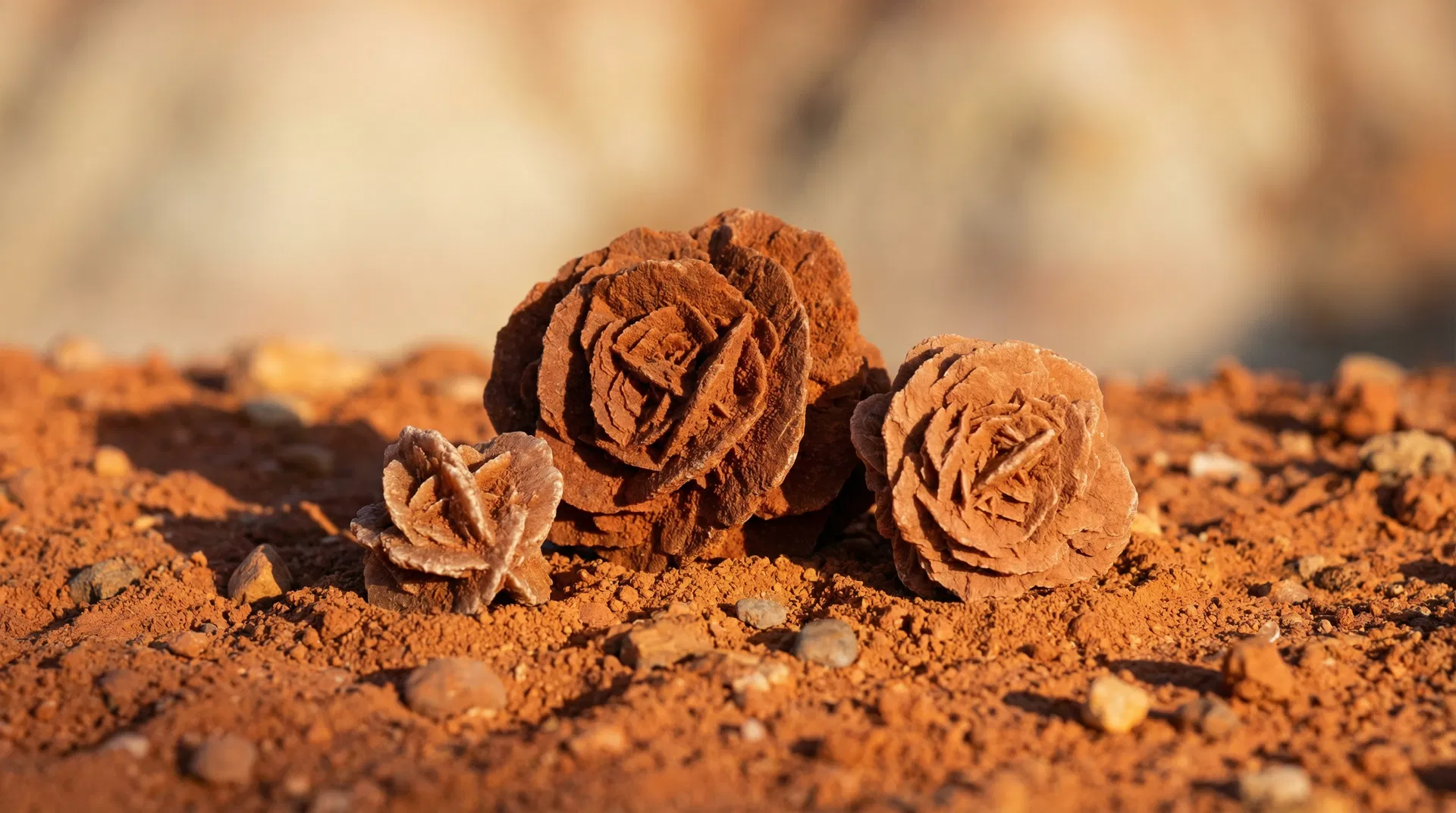
Oklahoma Rose Rocks—more formally known as barite roses—are amazing mineral formations that grow naturally in a rose-like pattern, with crystal "petals" spreading out from the center. Scientists call them barite roses because they're made of a mineral called barite, which has the chemical formula BaSO₄ (barium sulfate). But you don't need to remember that to appreciate how cool they are!
What Makes Them Look Like Flowers?
The secret is in how they grow. Barite crystals form in a radial pattern—that means they grow outward from a central point in multiple directions, just like petals opening from the center of a flower. These crystals are typically flat and disc-shaped, and as they stack and overlap while growing, they create that beautiful rose-like appearance.
What's really fascinating is that as these crystals grow, they trap tiny grains of sand from the surrounding soil. This gives Rose Rocks their characteristic rough, sandy texture and helps them hold their shape. It's like nature's way of building a flower out of stone!
Why are Oklahoma's Rose Rocks Special?
Barite roses can be found in several places around the world, but Oklahoma's Rose Rocks are considered geologically distinctive. The combination of barite crystal growth, sand incorporation, and iron-rich sediments found in parts of Oklahoma produces formations that most closely resemble a fully bloomed rose. That's why Oklahoma's barite roses have become so strongly associated with the state—they're truly one of a kind!
In fact, Oklahoma loved these natural treasures so much that in 1968, the barite rose was officially designated as Oklahoma's state rock. The city of Noble, where you can find an abundance of Rose Rocks, was proclaimed the "Rose Rock Capital of the World" in 1984.
That Beautiful Reddish-Brown Color
You might wonder why Rose Rocks have that distinctive rust or reddish-brown color. Here's the cool part: barite itself is actually white or colorless! The warm colors come from iron oxide (basically rust) present in Oklahoma's red soil. As the crystals grow, they incorporate this iron-rich sediment, giving them those beautiful earthy tones ranging from pale tan to deep reddish-brown.
The exact shade can vary depending on the local environment where they formed and how much weathering they've experienced over time. Some Rose Rocks are lighter and more peachy, while others are deep rust-colored—each one is unique!
What's in a Name?
Throughout history, these formations have been known by several names. Some people call them "desert roses," though that term is more commonly (and correctly) used for similar-looking formations made of gypsum found in other parts of the world. Older Oklahomans sometimes called heavily weathered specimens "walnuts" because of their rounded, bumpy appearance.
Today, "Rose Rocks" is the most common and widely accepted name in Oklahoma. It's simple, descriptive, and perfectly captures what makes these minerals so special. When you say "Oklahoma Rose Rock," people know you're talking about these unique barite-based formations, not gypsum roses from somewhere else.
A Quick Science Breakdown
If you're curious about the technical details, here's what Rose Rocks are made of:
Barite (barium sulfate) forming flat, disc-like crystals that create the "petals"
Quartz sand grains (SiO₂) trapped between and within the growing crystals, giving them texture and structure
Iron oxides (Fe₂O₃) that color the formations but aren't part of the barite structure itself
The combination of these elements creates Rose Rocks' characteristic appearance—rough, layered, and rose-like rather than smooth or glassy like some other minerals.
Want to Know How They Form?
The story of how Rose Rocks grow underground over millions of years is just as fascinating as what they look like. Discover the amazing geological processes that create these natural sculptures.
Learn How They Form